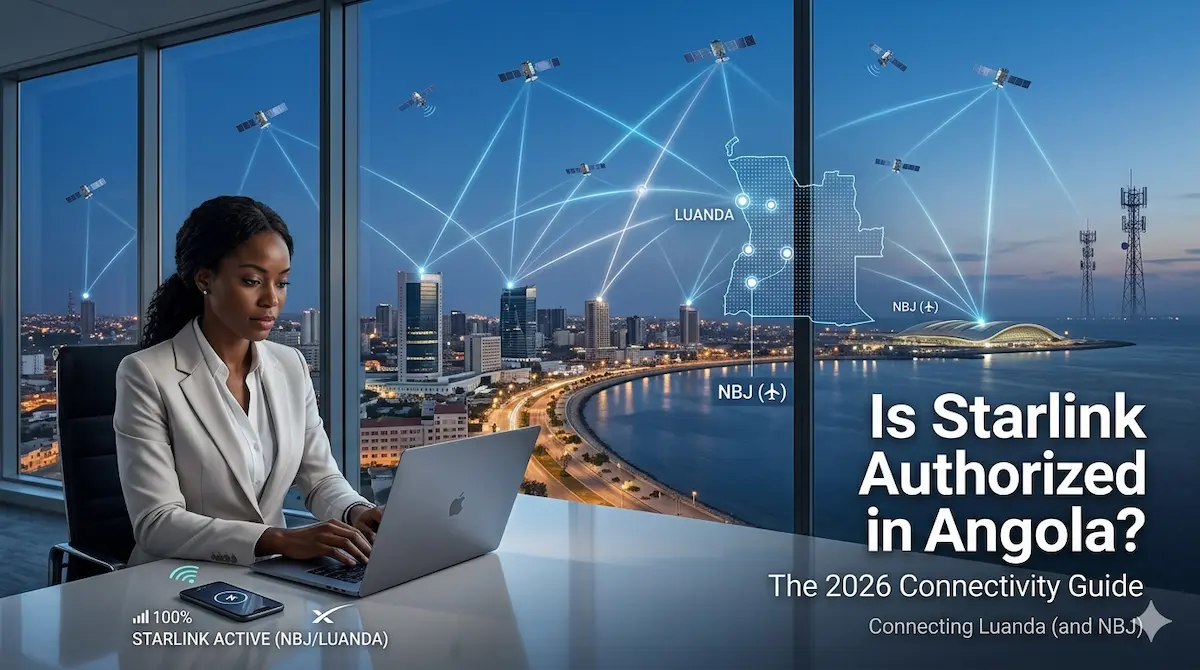
The Current Legal Status: Pending Approval
As of May 2026, Starlink is not yet officially authorized to provide services in Angola. While SpaceX has been in ongoing negotiations with the Angolan Institute of Communications (INACOM), the service remains in the 'pending regulatory approval' phase. Unlike several neighboring SADC countries that have already granted licenses, Angola is following a more measured approach to integrating low-earth orbit (LEO) satellite providers.
For professional travelers and local businesses, this means that there are no official distributors within the country, and the service is not legally protected. While the hardware is technically capable of receiving signals in the region, operating without a local license places the user outside the national legal framework.
Risks of Using Unauthorized Starlink Kits
Many travelers consider bringing Starlink kits from abroad using 'Global Roaming' plans. However, in 2026, this carries significant risks. Customs officials at the new AIAAN airport are briefed on non-certified telecommunications equipment. Importing a Starlink dish without INACOM certification can lead to immediate equipment seizure and potential fines.
Furthermore, Starlink has shown a commitment to national sovereignty by disabling roaming features in territories where they lack an active license. This means a terminal that works today could be geofenced and disabled tomorrow without notice, leaving a business operation without connectivity. For mission-critical tasks, relying on unauthorized hardware is a major operational risk.
Why the Delay? Sovereignty and Local Infrastructure
The delay in Starlink's entry is partly due to Angola's massive investment in its own digital infrastructure. The successful deployment of ANGOSAT-2 has provided the country with significant domestic satellite capacity. Recently, the government inaugurated the national Data Center and Cloud (RNA), signaling a clear priority for digital sovereignty and the protection of local telecommunications investments.
The regulator's goal is to ensure that when international providers like Starlink enter the market, they do so under a framework that supports local job creation, tax compliance, and national security standards. Until this framework is finalized, the government encourages the use of certified local partners.
Reliable and Authorized Alternatives in 2026
For those requiring high-speed internet in remote areas or as a backup for Luanda operations, there are several fully authorized alternatives. Local VSAT providers utilizing ANGOSAT-2 offer comprehensive coverage across all 18 provinces, from Cabinda to Cuando Cubango.
In urban centers like Luanda and Talatona, the 5G networks of Unitel and Africell now provide speeds comparable to satellite, often with lower latency. For professional setups, Hulukai recommends using these verified local networks to ensure continuous uptime and legal compliance during your stay.
Frequently Asked Questions
Can I buy a Starlink kit in Luanda?▼
No. There are currently no authorized retailers or distributors for Starlink in Angola. Any equipment sold locally is likely imported illegally and lacks official support.
Will my roaming Starlink work in Angola?▼
While it may technically connect, using it is a violation of local regulations. SpaceX may also disable terminals operating in unauthorized zones like Angola to comply with INACOM requests.
When is the official Starlink launch in Angola?▼
There is no confirmed date for 2026. While discussions are active, travelers should plan their connectivity needs around existing authorized providers until an official announcement is made.
Is it safe to bring a Starlink dish through AIAAN airport?▼
No. Non-certified telecommunications equipment is subject to inspection and seizure by customs. It is much safer to rely on local SIM cards or authorized satellite services.