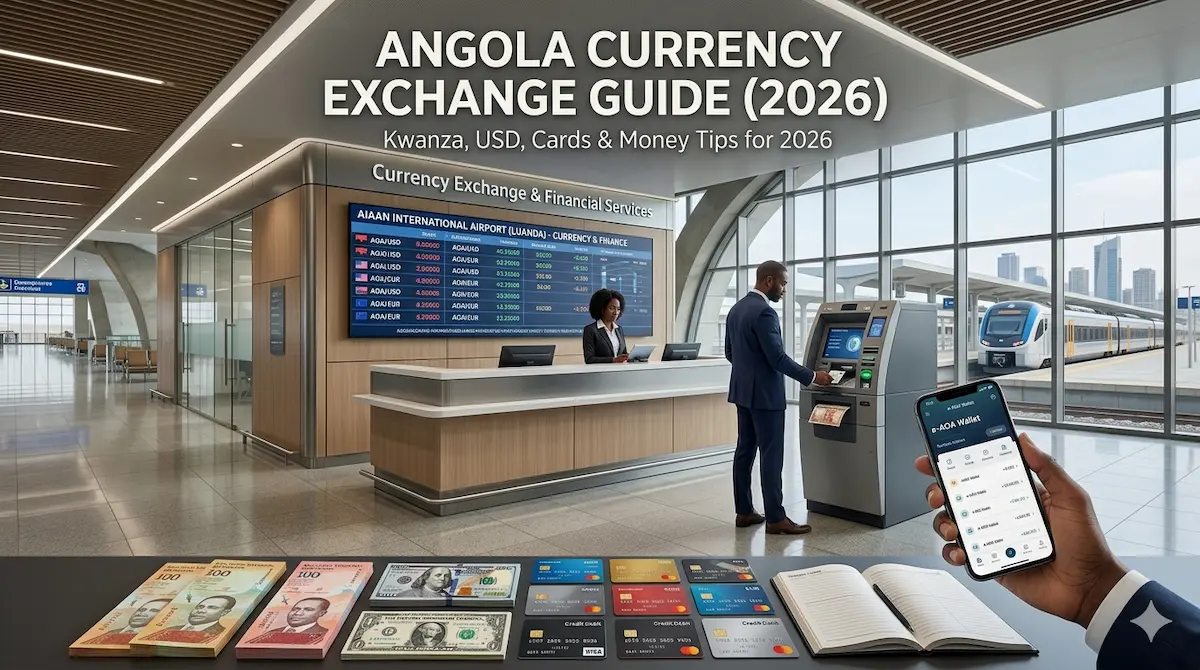
Understanding the Angolan Kwanza (AOA)
The Angolan Kwanza (ISO code: AOA, currency symbol: Kz) is the official currency of Angola. It is issued and regulated by the Banco Nacional de Angola (BNA), the country's central bank. The Kwanza was reintroduced in 1999, replacing the Kwanza Reajustado at a rate of one million to one, as part of economic reforms following the end of the civil war.
Banknotes are issued in denominations of 50, 100, 200, 500, 1,000, 2,000, and 5,000 Kwanza. Coins are less commonly used but exist in denominations of 1, 2, 5, 10, 20, and 50 Kwanza. In practice, most daily transactions are conducted using banknotes, and coins are primarily seen in supermarkets and formal retail settings.
The Kwanza is a relatively volatile currency, and exchange rates can fluctuate significantly. As of 2026, the exchange rate hovers around 910 to 980 Kwanza per US dollar, though the parallel (informal) market rate may differ from the official rate. The BNA has been gradually liberalizing the exchange rate regime, and the gap between official and parallel rates has narrowed in recent years.
Where to Exchange Money in Angola
There are several options for exchanging foreign currency into Angolan Kwanza, each with different rates and levels of convenience. The safest and most reliable option is to exchange money at a bank. Major banks in Luanda, including Banco de Fomento Angola (BFA), Banco Angolano de Investimentos (BAI), Banco Sol (Sol), Standard Bank and Banco de Credito do Sul, offer foreign exchange services at official rates. Bank rates are generally fair and transparent.
Authorized exchange offices (casas de câmbio) are another legitimate option. These licensed establishments are found in commercial areas, shopping centers, and near major hotels. They often offer slightly better rates than banks and have more convenient hours. Always verify that the exchange office is authorized by looking for the BNA license displayed on the premises.
What you should absolutely avoid is exchanging money with street vendors or unlicensed individuals. While the rates they offer may seem attractive, you risk receiving counterfeit notes, being short-changed, or becoming involved in illegal activity. The official exchange market is sufficiently competitive that there is no need to take these risks.
Using ATMs in Angola
ATMs are widely available in Luanda and other major cities, particularly at bank branches, shopping centers, gas stations, and hotel lobbies. Most ATMs accept international Visa and Mastercard debit and credit cards, though some networks (particularly American Express and Discover) may not be supported. The major banks with the most reliable international ATM networks are BFA, BAI, and Banco Sol.
Withdrawal limits vary by bank and card issuer but typically range from 50,000 to 200,000 Kwanza (approximately $55 to $220 USD) per transaction. Your home bank may impose its own daily limits and foreign transaction fees, so check with your bank before traveling. ATMs in Angola sometimes run out of cash during weekends or holidays, so do not rely solely on ATMs for your currency needs.
When using ATMs in Angola, take standard safety precautions. Use machines located inside banks or in well-lit, busy areas. Be aware of your surroundings and cover the keypad when entering your PIN. If an ATM retains your card, contact the bank immediately, your Hulukai driver or local contact can assist with this process.
Credit Cards and Digital Payments
Credit and debit card acceptance in Angola is growing but remains limited compared to many other countries. International Visa and Mastercard are accepted at most major hotels, upscale restaurants, large supermarkets, and modern retail stores. However, smaller establishments, street vendors, markets, taxis, and many local restaurants operate on a cash-only basis.
Multicaixa Express is Angola's dominant mobile payment platform and is widely used by locals for person-to-person transfers, bill payments, and purchases at participating merchants. However, to use Multicaixa Express, you need a local bank account, which makes it inaccessible to most short-term visitors. Some hotels may allow you to settle bills using international cards, but it is always best to confirm in advance.
Our recommendation is to carry sufficient Kwanza for daily expenses while keeping a credit card as a backup for larger purchases at established businesses. A practical approach is to budget approximately 30,000 to 50,000 Kwanza per day (approximately $25 to $45 USD) for meals, transportation, and miscellaneous expenses, plus additional funds for shopping, activities, or tipping.
Should You Bring US Dollars to Angola?
Bringing US dollars to Angola is a smart strategy, but with some important caveats. US dollars in cash (particularly $50 and $100 bills) are widely accepted for exchange and sometimes even for direct payment at hotels and tour operators. However, you will generally get a better overall deal by exchanging your dollars into Kwanza and using local currency for transactions.
When bringing US dollars, ensure that the bills are in good condition-crisp, untorn, and printed after 2009. Older series bills, particularly those printed before 2006, may be refused at exchange counters. Bills with any damage, tears, or writing will likely be rejected. Carry a mix of $50 and $100 bills for the best exchange rates, as smaller denominations sometimes receive less favorable rates.
Declaring large amounts of currency is both a legal requirement and a practical necessity. Angola requires declaration of any amount over $10,000 USD (or equivalent in other currencies) upon entry and exit. Keep your exchange receipts, as you may need them if you plan to convert any remaining Kwanza back to dollars when departing the country.
Common Currency Mistakes and How to Avoid Them
One of the most common mistakes visitors make is exchanging all their money at the airport. While airport exchange counters are convenient, the rates they offer are typically 10 to 20 percent less favorable than banks or authorized exchange offices in the city. Exchange just enough at the airport for your first day around 30,000 to 50,000 Kwanza, and do the rest in the city.
Another frequent error is not carrying enough cash. While cards are accepted at some establishments, the majority of transactions in Angola are still cash-based. Finding yourself without Kwanza when you need a taxi, want to buy something at a market, or need to pay a small vendor can be frustrating and embarrassing. Always carry a buffer of cash for unexpected expenses.
Finally, be cautious when dealing with pricing in dollars versus Kwanza. Some businesses may quote prices in USD for foreign customers, which can result in less favorable exchange rates than you would get by paying in Kwanza at the prevailing market rate. When in doubt, ask for the price in Kwanza and do a quick mental conversion to ensure you are getting a fair deal. Your Hulukai contact can advise on fair pricing for common goods and services.
Frequently Asked Questions
What is the best currency to bring to Angola?▼
US dollars in cash (crisp $50 and $100 bills) are the most convenient foreign currency to bring. They are widely accepted for exchange and sometimes for direct payment. Euros and South African Rand are also exchangeable. Other currencies should be converted to USD before traveling.
Are there ATMs at Luanda Airport?▼
Yes, there are ATMs at Dr. Agostinho Neto International Airport (AIAAN) in the arrivals area. They accept international Visa and Mastercard. However, they sometimes run out of cash during busy periods, so do not rely solely on airport ATMs. It is wise to bring some cash to exchange as a backup.
Can I pay in US dollars at hotels and restaurants?▼
Some major hotels and international restaurants may accept US dollars, but this is not guaranteed and the exchange rate offered is typically less favorable than the official bank rate. You will generally get a better deal by paying in Kwanza. Always confirm payment methods when booking.
How much money should I budget per day in Angola?▼
A reasonable daily budget for a visitor in Luanda is $50 to $150 USD per person, depending on your style of travel. Budget travelers can manage on $30 to $50 per day, mid-range visitors should expect $50 to $100, and luxury travelers may spend $150 to $300 or more. Accommodation is typically the largest expense.
Is it safe to carry large amounts of cash in Angola?▼
Carrying large amounts of cash is not recommended, as with travel to any destination. Use a money belt or secure bag, keep only the cash you need for the day on your person, and store the rest in your hotel safe. Use ATMs or exchange offices as needed rather than carrying all your funds at once.
Can I convert Kwanza back to dollars when leaving Angola?▼
Yes, you can convert unused Kwanza back to foreign currency at banks and authorized exchange offices, though you may need to present your original exchange receipts. The exchange rate for selling Kwanza back is typically less favorable than the buying rate, so it is best to exchange only what you need.